
Powell County's Present Owner Record
The Powell County PVA keeps the assessment side of each parcel record. The county publishes no public parcel portal. Its card layout is not published either. Request the card the office does maintain by owner name, situs, road, or parcel number. Ask which fields are public. Ask what year the data reflects.
| Owner name | Party assessed as owner for the stated period, if public |
|---|---|
| Mailing address | Destination for tax mail, not proof of occupancy |
| Situs | Physical-location field, if an address exists |
| Parcel/account | PVA identifier joining the owner and tract |
| Deed reference | Cross-check field only if the PVA maintains it |
| Assessment year | Period in which the listed owner and values apply |
An owner of record is just an assessment label. It does not name an occupant or certify title. Mailing and situs addresses often differ for good reasons, and rural land without a structure may carry no E911 address at all, so keep those fields separate when reading the parcel record.
Request Powell County Owner Fields
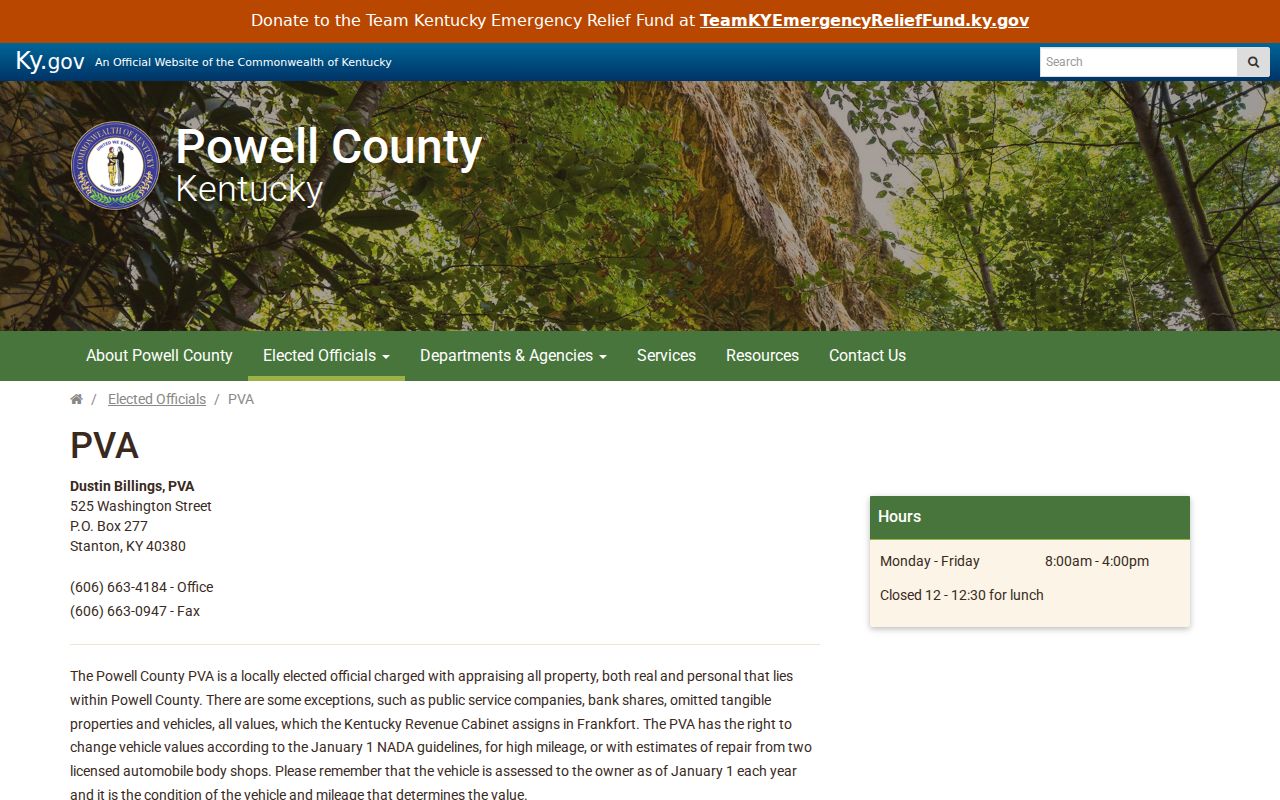
The PVA office is at 525 Washington Street, PO Box 277, Stanton, KY 40380. It lists (606) 663-4184 and weekday hours from 8:00 a.m. to 4:00 p.m., with a 12:00 to 12:30 closure. Phone, mail, and counter access matter because the official page was not a working owner-search screen.
Ask for an existing public assessment card, not a custom ownership analysis. Name the address or tract and request the owner field, parcel key, situs, mailing field, acreage or class, values, exemption indicator, and map or last-sale reference if maintained. A focused Kentucky Open Records request is a fallback for an existing record.
The official Powell County PVA page documents the assessment office route used to begin a current-owner check.
A good request also asks the office to name any field it does not maintain. If a map link, sale field, ownership history, or printed card is unavailable, that answer keeps a later property search from relying on an assumed feature. Save the office response date with the record.
How Fresh Is Powell's Owner Name
Powell County publishes no stated lag between recording a deed and refreshing the assessment owner name. Annual revaluation does not promise that yesterday's deed shows on today's PVA card. Compare effective dates carefully. When the card lists one owner and a later deed names another, ask a question. Does the deed postdate the tax roll? Search deed records for a correction, an estate transfer, or a trust. Also look for a court order or a still-later deed. Never overwrite one official result on a single conflicting hit. Words matter in this comparison. The PVA assesses a named owner. The Clerk records an instrument and indexes its parties. A court may order a transfer that a later deed implements. Those events and their dates explain most apparent conflicts in Powell County property records.
Recent sales need a deed check. The assessment roll can lag a transfer; the newest valid recorded deed may hold more current owner evidence.
Confirm Powell County's Current Owner
Treat the PVA name as a locator, not proof. Then check the Powell County Clerk's recorded-instrument route for the deed itself. The Clerk advertises eCCLIX but publishes no index start date, image coverage, or update cycle, so an office copy stays the fallback.
- Obtain the PVA card and note its year, owner label, parcel key, situs, and deed clue.
- Search that name as grantee and grantor in eCCLIX. Match the legal description and date.
- Check for a later correction, estate instrument, trust deed, or commissioner deed.
- For an LLC, inspect the Kentucky entity filing for only the roles it states.
- Owner of record
- The party carried on the assessment roll for the stated period.
- Assessment roll
- The PVA valuation listing, not a title opinion.
- Situs address
- The physical-location field, distinct from a tax mailing address.
- Recording lag
- The interval between a transfer and its appearance in another office's data.
Powell eCCLIX Access Conflicts
The Clerk's direct page says private citizens get five free Powell-only searches per day. A generic public-account page showed zero searches and restricted hours. Plan owner, entity, date, and instrument searches before logging in. Call (606) 663-6444 if the live terms differ. An index hit does not prove the image is online. Request the recording reference and ask about image or copy availability. The contact page lists weekday hours that conflict with a county page on the officeholder. Confirm before visiting.
Entity Owners in Powell Records
A current owner may be an LLC, trust, estate, trustee, executor, or commissioner. Preserve the exact name and capacity. A registered agent, permit applicant, or estate representative is not automatically the beneficial owner. The Kentucky Business Entity Search offers filing status, office, and agent clues. But it proves neither every person behind the entity nor every parcel held. The recorded deed and any court order carry the actual property link. Search the full legal entity name. Try punctuation variants and former names too. Match the capacity printed on the deed. If the owner record names an estate, compare probate dates with the recording date. If a commissioner appears, locate the court order. Find the deed that followed it, and do not label the commissioner the long-term owner.
Current Owners of Rural Powell Tracts
The county's Mapping and Road Location Center assigns E911 addresses. But Powell County says an undeveloped field or hillside gets no address until a footer or immovable structure exists. A failed street query may reflect the tract, not missing ownership. Search by nearest road, prior owner, creek, survey call, parent tract, or legal description instead. Ask the Mapping Center for road or E911 context. Then return to the PVA and Clerk for the parcel and deed. The county offers no public parcel viewer.
Powell Owner Name Monitoring
The County Clerk offers DOC ALERT. It is a free service that watches for deeds or mortgages filed under a personal or business name you register. A current owner can use it to catch an unexpected filing. The filing would show up against Powell County property records. The matching rules, validation controls, duration, and cancellation settings are not spelled out. Treat alerts as a tip, not a verdict.
An alert can miss things. A typo can slip past it. A trust variation, an entity name spelled differently, or a filing indexed under another party can slip past it too. The flip side happens too. A same-name person tied to different land may trigger a false match. So keep the legal description and recording reference handy. Compare each alert with the parcel record, and pull the recorded image whenever a filing looks off.
Build a dated owner file as your baseline. Include the current PVA card and the newest deed. Add the parcel number, the legal description, and any later corrections or releases. That file lets you test every alert against the right Powell County tract. For anything disputed, consult a legal or title professional before drawing conclusions.
Use Powell Owner Records Lawfully
A PVA mailing address is an administrative clue only. It does not prove the current owner of record lives there. Kentucky Safe at Home can substitute a protected address in many public records, though state compliance material treats real-estate holdings as an exception. Sensitive identifiers and protected addresses should never be republished.
Lawful use. Current owner data supports property diligence and civic research. It must never be used to watch, target, intimidate, or harass anyone.
For a wider route, see how to identify who owns a Powell County property. A title professional should resolve disputed title, unclear vesting, or conflicting legal descriptions.