
Compare Powell County Property Values
Every Powell County property value record carries a type and a year. The PVA estimates fair cash value, while a deed reports consideration from one transfer, and land and improvement fields split the total into its parts. Neither figure guarantees a future sale price.
| Value | What It Is | Where |
|---|---|---|
| Assessed value | Value carried for the stated assessment year | PVA assessment record |
| Fair cash value estimate | PVA estimate under Kentucky assessment rules | PVA record or explanation |
| Last sale consideration | Amount or consideration tied to a recorded transfer | County Clerk deed |
| Land and improvement | Separate components that may make the assessment total | PVA parcel card if maintained |
Kentucky requires real property to be assessed at estimated fair cash value. Special rules, such as agricultural value, apply in some cases. An assessed value is still administrative. It is a figure built for one tax year. A recorded sale may reflect financing, family ties, multiple tracts, or personal property. The tax roll captures none of that. Taxable value can shift again with an exemption. That makes the fair cash estimate, the sale consideration, and the tax base three different numbers, so record each label exactly as the custodian gives it and never convert one into another.
How Powell County Values Property
The Powell County PVA appraises real and personal property across the county. Kentucky Revenue recognizes sales comparison, cost, and income methods. Agricultural land can be valued differently. Its constitutional agricultural value replaces ordinary market value, and new construction is added to the roll each year.
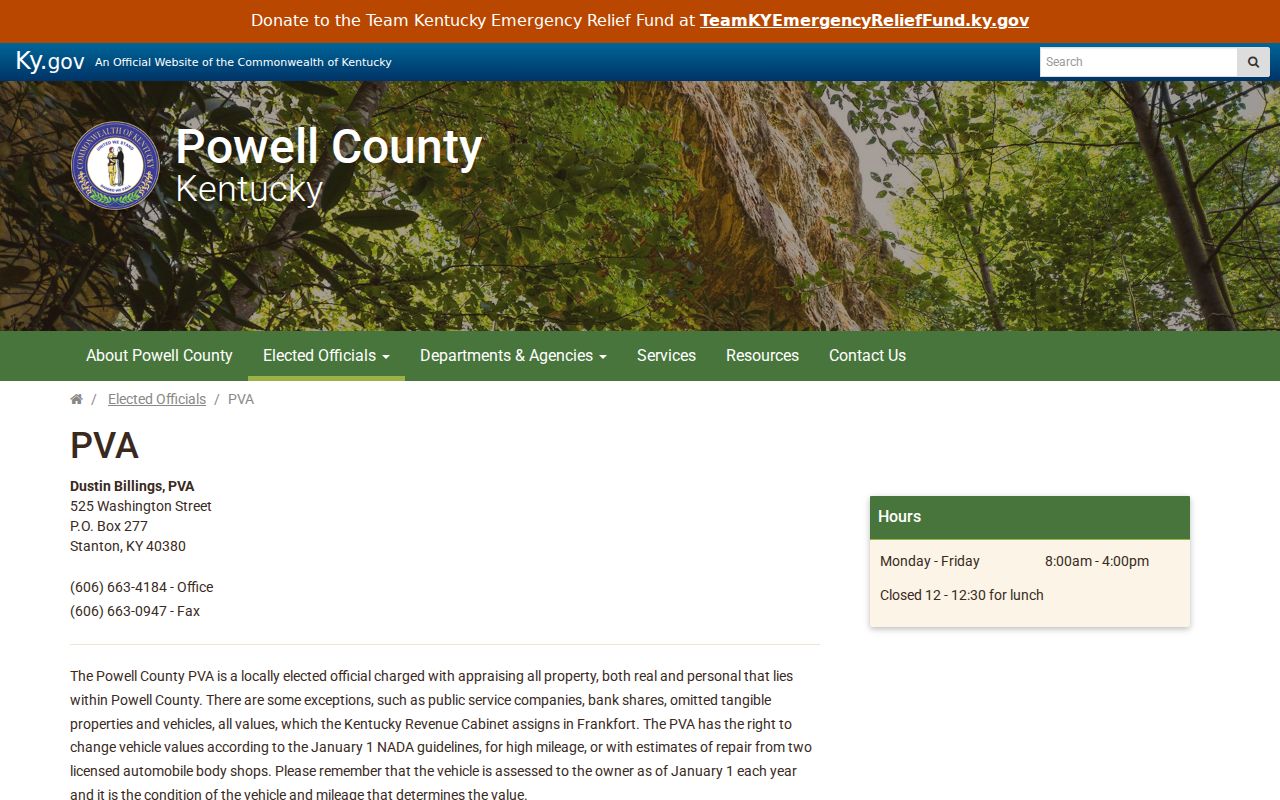
The county publishes no parcel-value screen. Land, improvement, total, class, and year still need direct confirmation. No parcel portal or card schema appears on the public pages. Request the existing assessment card. Ask which class, acreage, land value, improvement value, exemption, and sale fields it maintains. Never infer an undisclosed method from the total alone.
Annual Powell Value Updates
Kentucky Revenue says real property is generally revalued every year. Each parcel is inspected at least every four years. That schedule does not freeze values between visits. Sales data, new construction, classification, or other assessment work can move a later year. Write down the assessment year. Ask whether a figure is current, corrected, exempt, or under review. Without that date, one parcel's value cannot be compared fairly with another's. A parcel from a different year would not match. Physical inspection is not a private condition report. PVA work supports mass assessment. So it does not replace a buyer's inspection, settle title, fix a boundary, or stand in for a sale-specific appraisal.
Look Up Powell County Property Value
Powell County offers no public parcel-value screen. The dependable route starts with a PVA request by phone, mail, or counter. The Clerk matters only for a recorded sale.
- Give the PVA the address, road, owner, parcel/account number, or map reference.
- Request land, improvement, total assessed value, classification, exemption, and assessment year.
- Ask whether a last-sale field is maintained and what it represents.
- Check the actual deed through the Clerk when recorded consideration matters.
- Assessed value
- The value on the assessment record for the stated year.
- Fair cash value
- Kentucky's value standard for ordinary real-property assessment.
- Assessment ratio
- The relationship between an assessed figure and a market-value standard.
- Sale consideration
- The amount or value stated for a transfer, which may need context.
- Reassessment
- A later valuation update, separate from a private appraisal.
Powell Sale Price Needs Its Deed
The Powell County Clerk records page leads to eCCLIX for recorded instruments. Search by grantee, grantor, recording reference, or legal description. The index's earliest date and image coverage vary, so confirm details with the office. A PVA last-sale field is only a cross-reference. Read the instrument itself before calling a number a market sale. Deeds can cover several tracts. Their terms can distort the consideration. Record both the execution and recording dates whenever the instrument shows them. Then compare the deed description with today's PVA account. A split, consolidation, or parent tract can make an older figure a poor match for the current parcel.
Exemptions Change Powell Taxable Figures
Homestead, disability, religious, educational, governmental, and agricultural rules can all change how a Powell County parcel is classified or taxed. An exemption belongs to one eligible owner. It does not follow the land. Ask the PVA for the exemption year, category, application, and approval status. That distinction solves a common puzzle. Two similar assessed values can still tax differently. The bill details and appeal path sit with Powell County property tax records, not with what a value means.
Countywide Numbers Are Not Parcel Values
Census QuickFacts reports a median value of $141,100 for owner-occupied housing units covering 2020 through 2024. Owner occupancy sits at 68.2 percent. Those are countywide statistics. Nor are they an assessment or comparable sale. Use them only as broad Powell County context. A specific property value still needs its own PVA year, land and improvement facts, legal characteristics, and relevant sales. Attaching the county median to one Stanton or Clay City tract overstates what the statistic proves.
Compare Powell Values on Equal Terms
Match the labels first. Two Powell County property values compare honestly only when the assessment year, class, acreage, land value, and improvement value line up. Note exemption status too. Agricultural value may apply. A parcel with a home, several tracts, or recent construction explains much of its own total.
Sale figures deserve equal care. A recorded amount may bundle several parcels, a family transfer, a trust, personal property, financing terms, or a correction. Read the deed description and the transfer context. If a PVA card lists a sale, ask what that field means and whether the parcel has changed since.
Kentucky's assessment approaches answer different fact patterns. Sales comparison uses market evidence, cost weighs land plus improvements, and income fits property that produces income. The PVA publishes no statement of which method shaped a given Powell parcel's total. Ask rather than infer from one figure.
Good comparisons end with several forms of evidence. For a sale decision, a licensed appraisal and a current inspection settle facts the assessment file was never built to answer.
Limits of Powell County Assessed Value
An assessed value is no promise of sale price. It says nothing about a private inspection, title condition, a boundary dispute, an easement, or a current repair need. Terms of a particular sale stay outside it too. The assessment serves public valuation and tax administration for Powell County, nothing more.
Value is not price. Powell County assessed value supports taxation. It is not a sale forecast or licensed appraisal.
Hire a qualified appraiser for a live transaction. Pair that appraisal with the right title, survey, and inspection work. For bills, exemptions, and appeals, see Powell County property tax records.
Keep records together. File the PVA response, deed reference, and appraisal date side by side, because the source and effective date matter as much as the number.