
Identify a Powell County Property Owner
Who owns this land is really a two-record question here. The Powell County Property Valuation Administrator, the PVA, supplies the assessed-owner lead. The same office also confirms the parcel identity. The Powell County Clerk then holds the latest recorded deed. Keep the date and identifier from each response. A newer deed can run ahead of the assessment roll. Meanwhile, an old mailing address may still sit beside a perfectly valid owner field.
- Give the PVA the situs address, road, owner clue, or parcel/account number. Ask for the current public assessment card and its assessment year.
- Record the assessed owner, parcel identifier, situs, acreage or class, and any deed or last-sale reference the office maintains.
- Use the name and legal-description clues in the Clerk's eCCLIX records route. Locate the most recent deed naming the grantee.
- Compare dates, party names, and the land description. Ask the Clerk about the image or a copy when the index alone leaves doubt.
This route beats a name-only query. If the street address fails, try the road name. You can also try a former owner, the deed book and page, the legal description, or the Mapping Center. Some undeveloped Powell County land has no E911 address at all.
Keep a small audit trail as the property search moves along. Record the source URL, office name, date checked, search terms, result identifier, and any stated coverage limit. For answers given by phone, write down the office and the exact field confirmed. Those notes make later updates easy. They also keep an assessment lead distinct from a historic deed fact.
Powell County PVA Owner Clues
Powell County publishes no public parcel-search portal. The PVA office is therefore the sound first channel for owner information, not a promised online lookup. Ask by phone, mail, or in person for an existing assessment record. A precise request names the address or tract and asks for the public owner-of-record field, parcel or account number, situs, mailing address, acreage or classification, values, exemption indicator, and last-sale or map reference if the office maintains one.
The office sits at 525 Washington Street, PO Box 277, Stanton, Kentucky 40380, and lists (606) 663-4184. Hours run weekdays from 8:00 a.m. to 4:00 p.m., closed from 12:00 to 12:30. Call before you travel. The office page does not publish a card schema, refresh schedule, or typical recording lag, so ask for those details rather than assuming them.
The official PVA office page shows Powell County's assessment contact route and where appraisal ends and tax collection begins.
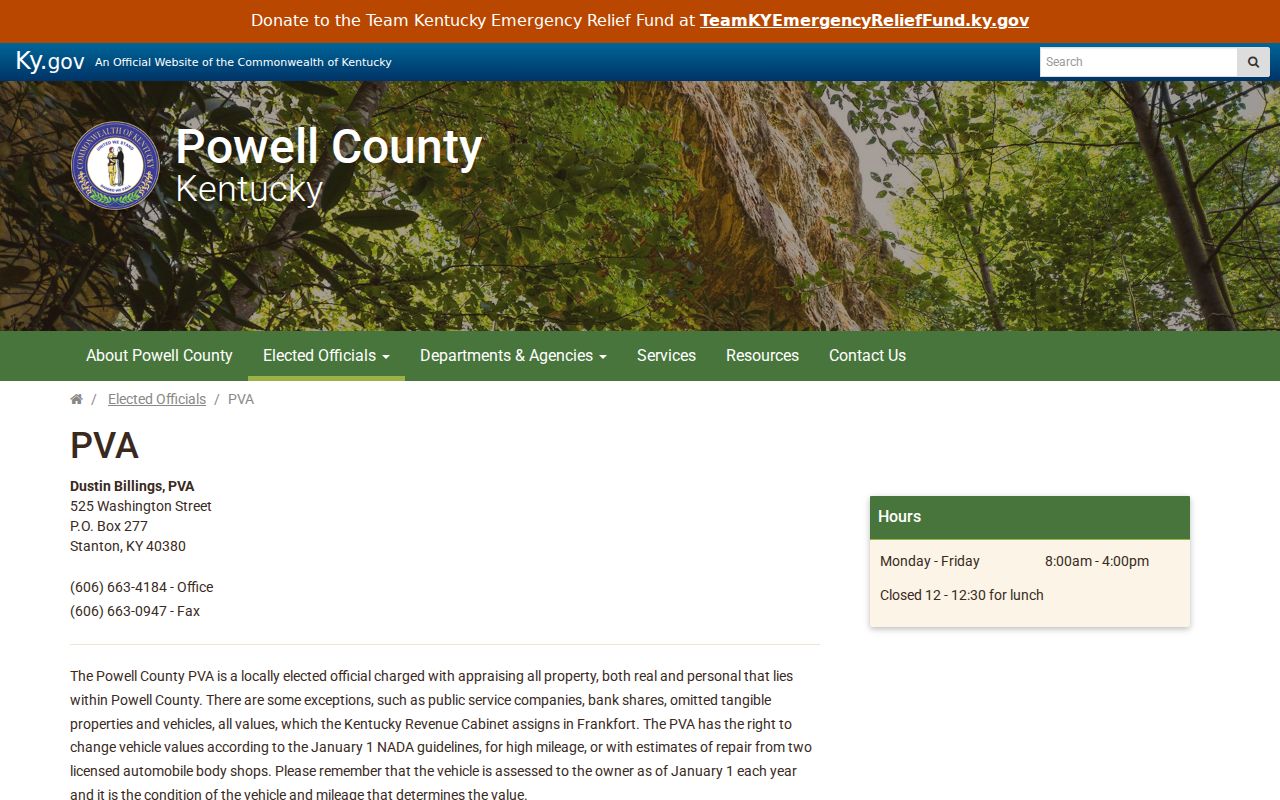
The official PVA page is an office gateway, not a parcel-result card. Owner fields still need direct confirmation from the staff.
Note: Ask the PVA to state the assessment year and the date its owner field was last refreshed.
Recorded Deeds Confirm Powell Ownership
The Clerk records deeds, correction deeds, plats, easements, mortgages, liens, releases, and other land instruments. Its eCCLIX page describes free Powell-only access for private citizens, with five searches per day. A generic public-account notice gave conflicting terms. Plan your party names and date range first. If the access terms do not match the direct Clerk page, call (606) 663-6444.
A deed index hit is only a locator. The deed itself names the grantee receiving the stated interest. It also carries the legal description or a prior reference. Do not treat one hit as final. Search for later corrections, estate instruments, trust documents, court deeds, and releases. The Clerk does not publish the index start date or image completeness. In-person, phone, and mail requests remain solid fallbacks for deed records.
Powell County Ownership Terms
Record labels can look alike while doing different jobs. These terms keep a Powell County property owner search precise.
- Owner of record
- The name carried on the PVA assessment roll for the stated assessment period.
- Grantee
- The person or entity receiving an interest in a recorded instrument.
- Title
- The legal ownership interest, which an assessment name or index result alone does not establish.
- Situs address
- The property's physical location, distinct from the address used to mail tax notices.
- Parcel identifier
- The PVA account or parcel key used to keep the assessed tract distinct.
A mailing address that differs from the situs tells you nothing about occupancy. It may simply be the address the owner chose for the tax bill.
Powell County Ownership Sources Compared
The owner question crosses several official sources. Each plays a distinct role, and Powell County offers no countywide public GIS viewer that joins them all.
| Where Ownership Appears | What It Gives | How Current |
|---|---|---|
| PVA assessment record | Assessed owner, parcel, situs, mailing and value fields if maintained and public | Ask for assessment year and refresh date |
| County Clerk deed index | Grantor, grantee and recording reference for a transfer | Compare the newest recorded deed |
| Secretary of State entity search | Entity filing, agent, and office information | Current filing status, not beneficial ownership |
| Mapping Center response | Road, E911, structure and map context | Ask for the map date and source |
The Kentucky Business Entity Search helps decode an LLC name on a deed. It cannot prove every beneficial owner or every parcel the entity holds. A permit applicant may likewise be a contractor or agent. The applicant may not be the owner of record. Keep each name tied to the exact role the record states.
Trusts and Estates in Powell Records
A Powell County property owner may appear as an LLC. The owner may also appear as a trust, estate, executor, trustee, or commissioner. Search the full entity name and its spelling variants. For an estate, compare the decedent, the representative, the recipient, and the recorded transfer. Those roles can carry different names. A probate order may lead to a later deed or affidavit. The PVA may still show an older assessment name while that work is pending.
When an entity appears, check the Secretary of State filing. It can supply a registered agent or office clue. It still cannot prove who holds every economic interest. When a court order affects the parcel, use the Powell Circuit Clerk or CourtNet to locate the case. Then return to the County Clerk for the instrument that implemented the result.
Rural Powell Owner Search Fallbacks
Rural tracts in Powell County often fail a simple address lookup. The Mapping and Road Location Center issues E911-certified addresses only for structures. So an undeveloped field or hillside without a footer may never receive one. A deed tract can sit on the county books for generations. Before then, no modern situs address exists.
The workaround is office-first. Contact the Mapping and Road Location Center armed with clues: the nearest road, an intersection, coordinates, a landmark, a prior owner, or a legal description. Staff can match those details to a parcel. Powell County publishes no public parcel viewer. So take the road or E911 answer back to the PVA and the Clerk to finish the property records trail.
Monitor Powell County Owner Names
Finding who owns this property is rarely the last step. The Clerk links a free Powell DOC ALERT signup. It sends a notice when a mortgage or deed is filed under a registered personal or business name. That makes it a practical guard against deed fraud.
Know the limits. The service watches names, not parcels. A typo, an entity variation, or an instrument indexed under another party can slip past it. An alert is not a title report. It cannot prove that every filing touches the same property records. Periodic review of the Clerk's deed index remains wise.
Limits of Powell County Owner Records
A name in the property records is not a person at the door. Assessment rolls and deed records track parcel interests. They never show who is physically present at an address. Data can be stale, or thin online. It can also be indexed under a spouse, an estate, a trust, a business, or a former road name.
Kentucky Safe at Home substitutes a substitute address in many public records. State compliance material carves out real-estate holdings as an exception. Handle sensitive identifiers and protected addresses with care.
Use the record with care. A roll name is not a title search, and ownership may rest in an LLC, trust, estate, or court-directed transfer. Powell County owner information is for lawful property diligence and civic research, never harassment or targeting.
For a closer look at present records, the Powell County current owner page walks through comparing the assessment name against the newest deed. Leave marketable-title questions, conflicting legal descriptions, and disputed interests to a title professional.