
Trace Powell County Former Owners
Begin with the newest recorded deed and read backward through Powell County property records. Every deed should name the grantor and the grantee. It should also list the date, the deed type, and the recording reference. Match the legal description before adding any name to your chain. The Clerk's eCCLIX entry point helps with a Powell County property search. The office publishes no first indexed year or full image range, though.
| Transfer Date | Grantor to Grantee | Deed Type | Book/Page |
|---|---|---|---|
| Newest transfer | Immediate seller to present grantee | As recorded | Copy exact reference |
| Prior transfer | Earlier seller to that grantor | As recorded | Follow prior-deed citation |
| Earlier transfer | Repeat with the former grantee | Check corrections or estates | Match land calls |
| Book-era transfer | Use reverse and direct indexes | Read full instrument | Record volume and page |
Treat this timeline as a worksheet, not a finished chain. Never invent dates or names. Start from the most recent transfer. Then work backward through prior references, grantor searches, and land calls until the chain reaches its earliest link. If an instrument has no image online, request a copy from the Powell County Clerk.
Powell's Online Deed Cutoff Is Unconfirmed
The Clerk records page connects to eCCLIX. It lists five free Powell-only searches per day for private citizens. A separate account notice muddies that, showing zero searches and restricted hours. Either way, the terms matter less than the coverage gap. Neither page publishes the earliest indexed deed. It also leaves the full range of images unpublished, and a former-owner search depends on that most.
The Clerk's records page shows how Powell County deed-chain research reaches eCCLIX.
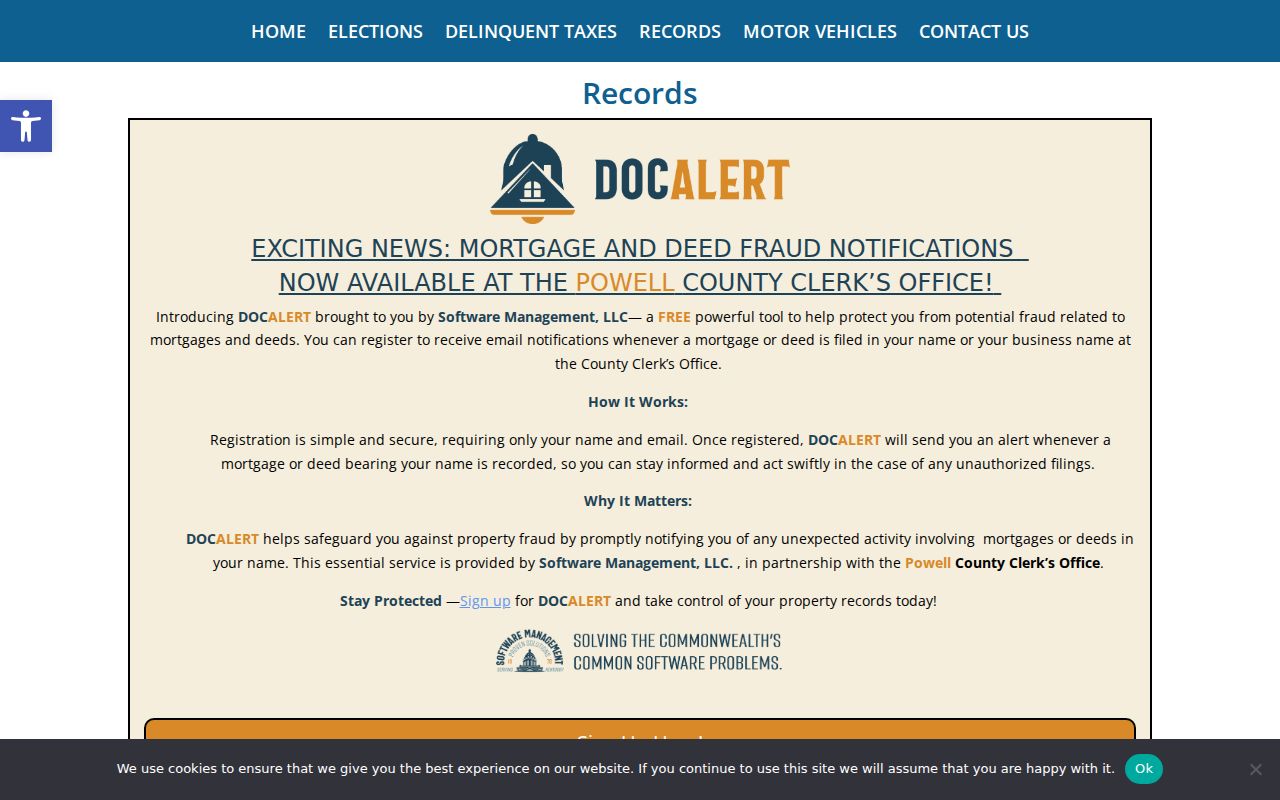
This is not a sample deed result. Every former-owner entry needs its own recording reference and a legal description that matches the parcel. That work falls on the researcher, record by record.
Do not assume an online cutoff year. Ask the Clerk instead: the first indexed year, image availability, reverse-index access, and where the older direct and reverse deed books live. When login terms, coverage, or images fail, the office, phone, mail, and courthouse routes form the fallback chain.
Coverage remains a gap. Powell's online starting year was not published; older owners may require deed books, office copies, microfilm, or archival help.
Old Powell Roads Hide Prior Owners
A modern address makes a poor historic key. Roads get renamed. City limits shift. A rural tract may wait for an E911 address until a structure stands on it. Older Powell County deeds often point instead to a creek, a ridge, a neighbor, a survey, an acreage figure, or a parent tract rather than a street number.
The Mapping and Road Location Center can supply road-name and E911 context. Keep the old wording intact. Then return to the Clerk's deed books. The legal description and prior recording reference link former owners far better than a current ZIP label.
Read Powell's Deed Chain Backward
Work the deed chain in reverse. Each seller becomes your next search subject in the Powell County property records. Keep a dated log as you go, so spelling variants, repeated family names, and similar tract descriptions stay separate.
- Find the present grantee's acquiring deed and save its full recording reference.
- Read the grantor, legal description, exceptions, and prior-deed citation.
- Search that grantor as an earlier grantee, including spouse, estate, trust, and entity variants.
- Repeat until online coverage ends, then continue through direct and reverse deed-book indexes.
- Grantor
- The party conveying the stated interest.
- Grantee
- The party receiving that interest.
- Chain of title
- The ordered sequence of instruments tied to the same land.
- Reverse index
- An index used to locate a party in the grantee role.
- Quitclaim and warranty deeds
- Different deed forms that still require the actual text and later chain to be read.
Powell Microfilm Is a Catalog Lead
Powell County's paper trail runs through Clerk volumes and court records. Microfilm and catalog layers were added later. The FamilySearch catalog entry for Powell miscellaneous bonds spans 1915 through 1990. It notes an index in every volume. That tells you some Clerk material was filmed. It does not prove Powell deed books share those dates or sit online.
Treat the catalog as a custody clue. Ask the Clerk or the Kentucky Department for Libraries and Archives which deed series, volumes, indexes, film, or digital images exist. Include the approximate year, every party name variant, and the former road. Add any city clue and the parent tract. A specific request gets a specific answer about the parcel records you need.
Estate Transfers Break a Simple Chain
Not every former owner left through a routine sale. An estate, executor, heir, trustee, commissioner, affidavit, or court order may carry the transfer instead. Search the decedent as former owner, the representative as grantor, and the recipient as grantee. Then compare the probate dates against the later recorded deed.
A probate order explains a transfer, but it never replaces the deed itself. CourtNet or the Powell Circuit Clerk may hold the case file. The County Clerk keeps the recorded instrument. Rely on the legal description to separate several parcels tied to one estate.
Partition, foreclosure, quiet-title, and boundary cases break chains too. Hunt for a final order, confirmation, commissioner report, dismissal, or appeal. Then trace any deed recorded from that outcome. A caption alone proves nothing about land changing hands in the property records.
Corrections Change Powell Owner Trails
Owner trails bend and sometimes snap. A correction deed, affidavit of descent, commissioner deed, quitclaim, trust instrument, or plat reference can repair the trail. It can also send it somewhere new. Search mortgages, releases, easements, restrictions, liens, and lis pendens only when they explain a transfer. Search them as well when they cast a cloud on title. A named party in those documents is not automatically an owner of record.
Read the actual image every time. Index entries omit attachments and exceptions. A later correction may fix a clerical point without moving the intended tract. A court-directed deed can follow a judgment or a confirmed sale. Preserve each record's own verb: recorded, indexed, ordered, released, assessed.
Mineral interests, easements, leases, and restrictions can outlast a change in surface owner. Add them to the chronology when they shape its meaning. Keep their parties out of the former-owner column, though. It makes no difference how often they surface in the land index or tax roll.
Waltersville Clues in Older Powell Deeds
Clay City has not always carried that name. The town's official history records a stretch when it went by Waltersville, tied to local ironworks before its 1890 incorporation. That detail matters for Powell County records. An older deed may cite a vanished place name, a creek, a forge, a ridge, or an adjoining family instead of the current city label.
If a chain of title stalls near Clay City, put Waltersville in your notes. Search every known party. Try spelling variants and land calls too. The Collins, Clark, and Smith names in the municipal story are historical vocabulary, not proof that any of those families held the tract in question. Only the deed index, the recorded instrument, and a matched legal description can tie a name to the land.
The local library and KDLA may identify old maps, newspapers, or record series that explain a forgotten road or community name. Bring each clue back to the Clerk. Check the direct and reverse indexes. Local history solves names; it never decides title.
How Far Back Powell Owners Go
Powell County's earliest deed book is an open question. The same goes for any online cutoff or records-loss event. Those facts belong with the Clerk or the archives. KDLA research guides point to deeds, wills, order books, and court cases. Those are the useful series. Local library history files can still resolve old place names.
Use history with care. Prior-owner research supports house history, estates, and property diligence. Never use it to track, target, or harass a living person.
A catalog entry is not a certified deed. The Clerk and a title professional must resolve the current legal chain of title. For the copy rules on a single instrument, consult the Powell County deed records page. Only transfers matched to the same tract count.